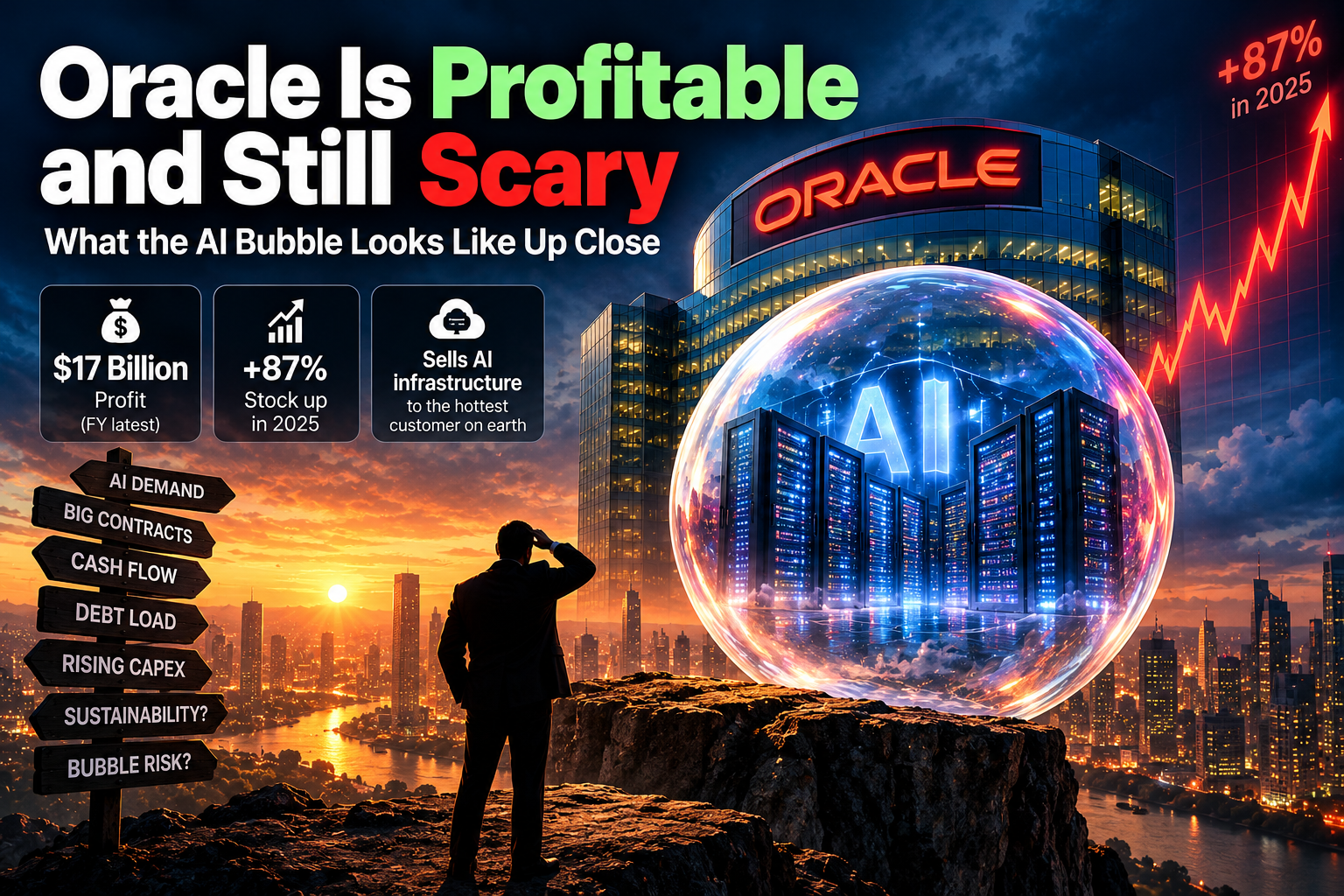
The Oracle AI bubble is a strange story: a company made $17 billion in profit and still became the market's favourite worry. That is not a contradiction. It is a business model flipping in public.
Oracle is not a loss-making company. It sits on a pile of cash, it sells AI infrastructure to the hottest customer on earth, and its stock was up 87% in 2025. Yet investors now ask whether it can carry its debt.
To understand why, you have to understand how Oracle got rich in the first place.
The problem Oracle solved
In the 1970s, banks had giant computers but fragmented data. Savings, loans and credit cards each kept their own copy of a customer. If a customer moved from Goa to Mumbai and updated one system, the other two kept mailing the old address.
Worse, the loan desk could not see that a customer had healthy savings and a clean card record, so no home loan offer ever went out. Or it could not see missed card payments, and approved a loan it should have refused. A simple question like "how many Mumbai customers have both a loan and a card?" turned into a weeks-long IT project.
Larry Ellison and his co-founders shipped the first commercial SQL database. For the first time, the bank saw one customer, not three records. The product won because it fixed a real business problem, not because it was clever.
The golden rule, and the miss
For three decades Oracle's rule was simple: customers own the machines, Oracle sells the software. Customers paid for servers, cooling and engineers. Oracle collected licence fees at roughly 70% gross margins.
Then AWS arrived in 2006 and said: do not buy servers, rent them by the hour. Startups got enterprise-grade computing with zero upfront cost. Ellison mocked the cloud for years and did not take it seriously until 2016. By then, new licence sales had fallen 15% in a year and revenue had slipped from $38.2 billion to $37 billion.
I see the same pattern in enterprise software today. The incumbent rarely loses because it is stupid. It loses because its best business model is also its biggest blind spot.
The Oracle AI bubble starts with a $455 billion order book
Then came September 2025. Oracle reported remaining performance obligations of $455 billion, against Wall Street's expectation of about $180 billion. Most of the gap came from OpenAI agreeing to rent computing power for around $300 billion over five years, starting in 2027.
That is roughly $60 billion a year, from a customer whose revenue at the time was about $12 billion a year. Oracle's own operating cash flow was about $21.5 billion. Both companies were stretching far beyond their size.
Oracle had not earned a single dollar from the deal. The stock still jumped 36% in one day, and Ellison briefly became the richest person alive. Markets pay for expected tomorrow, not earned yesterday.
From software to concrete
Here is the part that matters. To serve that contract, Oracle had to become something it never was: an asset-heavy business. Land, buildings, power and Nvidia chips, all before a rupee of rent arrives. Gross margins drop from about 70% to somewhere around 30 to 40%.
The numbers are stark. Oracle spent $56 billion on construction and equipment in fiscal 2026, then another $28 billion in the next three months. That is $84 billion in 15 months against about $55 billion of cash generated. The gap was filled with debt.
The J-curve in plain numbers
Spend $100 to build something that earns $30 a year. You sit at minus 100, then minus 70, minus 40, minus 10, and only turn positive in year four. Every build-now, rent-later business has this shape.
Three things break it:
- The customer pays a year late, and interest keeps running.
- Rent falls from $30 to $20, and break-even stretches from 3 years to 5.
- Chips go obsolete in 4 years, and you must replace them before you ever profit.
All three started showing up. Doubts grew about whether OpenAI can afford $60 billion a year. Some data centre timelines reportedly slipped to 2028. OpenAI reportedly dropped expansion at a flagship Oracle site because it wanted newer Nvidia chips elsewhere. The chips moved faster than the concrete.
The stress test
Three steps to a heavy interest bill
Start with Oracle at about $27 billion of annual profit, paying about $5.7 billion in interest.
- Borrow another $40 billion at 7%, and interest rises by roughly $2.8 billion, to $8.5 billion.
- Refinance about $17 billion of old loans, borrowed when money cost 1.65%, at around 6.5%. Interest climbs to about $9.5 billion.
- A delayed data centre or a price war pulls profit from $27 billion down to $20 billion.
Now nearly half of everything Oracle earns goes to lenders.
The interest bill only goes up, because debt is fixed. Only profit can fall.
The credit market agrees. Insuring $1 million of Oracle debt once cost about $5,000 a year, and barely touched $12,000 even during COVID. It has now reached about $20,000, a 200 basis point spread. Lenders are four times as nervous.
The case for the optimists
This is not a death story. OpenAI has reportedly closed a $122 billion round at an $852 billion valuation, and its revenue is approaching $70 billion annualised. Oracle's order book has grown to $664 billion, with new customers joining. The bulls may well be right.
What I take from this
I spend my days with enterprise customers who buy outcomes, not promises. The Oracle AI bubble reinforces a lesson from my own work: a signed contract is not cash, and an order book is not a profit.
The AI boom is real. The question is who carries the financing risk while the revenue catches up. Whoever borrowed the most to be early is the one the market now watches.
A signed contract is a promise. Cash is a fact. Debt does not care which one you were counting on.
Oracle once won by letting customers carry the infrastructure. It now carries it all itself. Whether the Oracle AI bubble turns out to be genius or overreach depends on one thing: who blinks first, the customer's cash or the lender's patience.